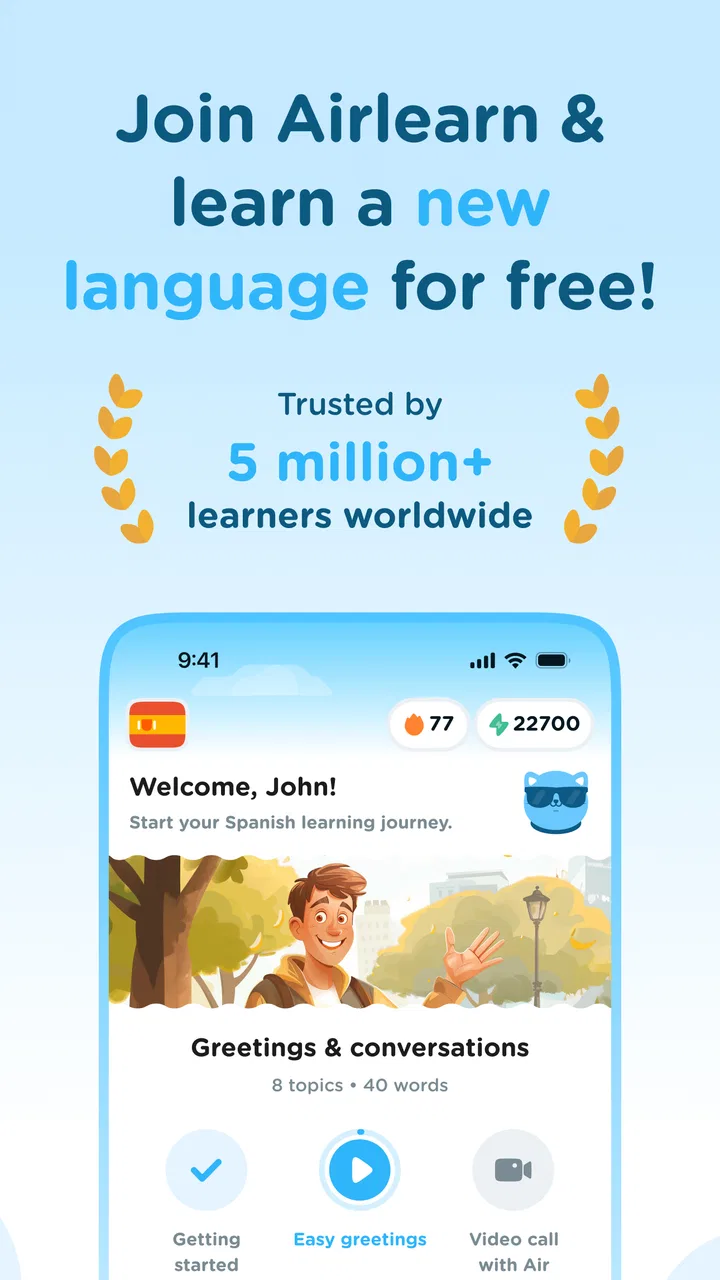
Airlearn - Language Learning
- 4.6
- Rating
- 5.00M
- Installs
- Free
- Price

 Analysis by App-foxy
I tried Airlearn as a practical language-learning app rather than treating it like a quick vocabulary game, and that is the best way to understand where it fits. It is an education app from Airlearn Tech that brings Spanish, French, Japanese, Korean, German, Chinese, Russian, and Italian into one place. The free starting point makes it easy to test, while optional purchases range from $4.99 to $124.99 per item, so the real question is not simply whether it opens on your phone. It is whether its learning style matches the way you actually study.
My overall impression is positive, especially for someone who wants a guided language habit without assembling several separate tools. The app has a 4.7 average from around 35 thousand ratings and has passed one million installs, which suggests that it has found a sizeable audience. Still, popularity does not remove the usual frustrations: choosing the wrong language, losing momentum, expecting instant fluency, or assuming that a lesson app can replace real conversation. I found Airlearn most useful when I treated it as a daily practice companion rather than a complete language course.
Where Airlearn Can Feel Less Straightforward
I found that Airlearn is easiest to judge when I separate learning friction from app friction. A lesson that feels slow may simply reflect a new writing system or a tired moment, while a loading problem calls for a different response. I start by identifying which kind of difficulty I’m facing; the next section looks at a few setup checks that can make that distinction clearer.
You May Also Like

 Blood Strike: 2.5 Anniversary
Blood Strike’s Loadouts Turn Every Drop Into a Tactical Gamble
A close look at Blood Strike’s custom loadouts: how fast access to signature weapons reshapes its battle royale rhythm, rewards preparation, and narrows the gap between fights.

 Pandora - Music & Podcasts
Pandora’s Music Is Easy to Start, but Harder to Recover
Pandora’s strength is its low-effort path from a seed to a station. Its weak spot is how much confidence it asks you to place in connection, setup, and quiet recovery.

 8 Ball Pool
 Is Built on Rivalries, Rematches, and Routine
A close look at the rivalries, rematches, shared routines, and unanswered safety questions that turn a quick pool match into a persistent mobile community.

 Samsung Music
’s Quiet Strength Is Playing What You Already Own
Its reach comes less from spectacle than from dependable access to a personal library. That simplicity is both the app’s strongest retention engine and its ceiling.

 AccuWeather: Weather Radar
AccuWeather Review: A Quick, Clear Forecast for Everyday Decisions
For everyday plans, the best forecast is the one you can understand quickly. AccuWeather makes rain timing, radar, and local conditions easy to act on, with a few trade-offs.

 Hill Climb Racing
Why Hill Climb Racing Still Turns Crashes Into One More Run
A tiny car, a bumpy hill and one more upgrade: Hill Climb Racing keeps resurfacing because its simple chaos makes every near-miss feel personal.
More From Our News Desk



Choosing a language is an important first decision
The first potential stumbling block is not technical. It is choosing a target language and an appropriate starting point. Airlearn covers languages with very different writing systems and pronunciation demands. Spanish and Italian can feel familiar to some English speakers because of shared vocabulary, while Japanese, Korean, Chinese, and Russian introduce a different early workload. If you select a language casually and later switch, your progress routine may no longer feel coherent.
I recommend deciding what you want before beginning: travel phrases, basic conversation, reading practice, or a long-term study habit. That small decision changes how you judge the app. A person preparing for a holiday may care about useful expressions and recognition speed. Someone studying Japanese or Chinese may need patience with script and sound distinctions. Airlearn can support the first steps in either case, but the learner still has to bring a realistic expectation.
Short practice is convenient, but it can encourage shallow progress
The app is easy to approach in small sessions, which is one of its strongest qualities. I could imagine using it while waiting for a bus, during a lunch break, or before bed. The trade-off is that a short session can create the feeling of progress without enough time for deeper recall. Recognizing an answer immediately is not the same as producing it later in a real conversation.
To avoid that trap, I would pause before revealing an answer and say the phrase aloud. For writing-system languages, I would also copy unfamiliar characters by hand instead of relying only on recognition. This turns a quick lesson into a more active exercise. The most useful Airlearn habit is to make each session slightly harder than the screen requires.
Free access and paid choices need a deliberate approach
Airlearn is free to download and use as an entry point, but it also includes in-app purchases. The listed purchase range is $4.99 to $124.99 per item, so I would not commit to a paid option until I had tested whether the lesson rhythm suits me. A subscription or purchase can be worthwhile for a learner who returns consistently, but it is poor value for someone who studies enthusiastically for two days and then stops.
I also think the purchase decision should be separated from the language decision. First decide whether the app helps you study. Then decide whether extra access is worth paying for. That prevents the common mistake of paying for motivation instead of building a routine that already works.
What the app cannot replace
Airlearn is not the right single tool for someone who needs detailed grammar reference, teacher feedback, formal exam preparation, or regular conversation with native speakers. A textbook may explain exceptions more carefully. A tutor can correct pronunciation and sentence choices in context. A conversation exchange can expose you to hesitation, slang, and imperfect real-world speech.
That does not make Airlearn weak. It gives the app a clear role: it is a convenient way to keep contact with a language between more demanding activities. I would use it alongside listening, speaking, and occasional written practice rather than asking it to carry the entire learning plan.
Setup Checks That Prevent Common Friction
Before I settle into a routine, I like to remove avoidable sources of trouble: confirm that my phone can run the app, choose a dependable connection, and make sure I can study without constant interruptions. Those small checks are especially useful when I’m trying a language with unfamiliar sounds or characters. Once the basics are in place, I can tell whether the learning workflow itself needs attention.
Start with the phone and account basics
Airlearn requires Android 11 or later, so compatibility is the first check for Android users. If the app will not install or behaves strangely, I would confirm the operating system before trying more complicated fixes. On an older device, a failed installation may have nothing to do with the app itself.
I would also make sure the phone has a stable connection during installation and the first launch. A weak connection can make an app appear stuck, leave content loading slowly, or create the impression that a lesson is unavailable. Switching between a reliable Wi-Fi connection and mobile data is a simple way to identify whether the problem is connectivity rather than the application.
Choose your study conditions before judging the experience
Language practice is sensitive to interruptions. If notifications, low battery, or a crowded commute repeatedly break a session, the app may seem less effective than it really is. I get better results by opening it with a clear ten-minute window, headphones if I am working on pronunciation, and enough quiet to repeat unfamiliar words.
This is especially important for Korean, Japanese, Chinese, and Russian, where early unfamiliarity can make every exercise feel slower. A rushed session is not a fair test of the course. I would try several sessions at different times of day before deciding whether the pacing works for me.
Set a useful baseline instead of pretending to be a complete beginner
If you already know some Spanish, French, German, Italian, or another supported language, do not automatically treat every familiar word as mastered. Use the early material to identify gaps in recall. I often recognize a word when reading it but fail to produce it when speaking, and that difference matters more than a comfortable first impression.
For a language with a new script, the opposite problem can occur: the initial material may feel difficult simply because the symbols are unfamiliar. I would separate script learning from vocabulary learning in my mind. Slow recognition at the beginning does not necessarily mean the app is unsuitable; it may mean that the target language demands a different warm-up.
Keep purchase choices separate from troubleshooting
If a lesson or section seems unavailable, I would first check the connection, restart the app, and confirm that the latest installed version is behaving normally before assuming payment is required. The current version is 3.12.48, and keeping the app updated is a sensible general maintenance step. I would also avoid repeatedly tapping a purchase button when the store screen is slow, because that can create confusion about whether an action went through.
For billing questions, the safest approach is to review the purchase screen carefully and use the relevant app-store account tools. I would not regard reinstalling as a solution to a payment problem. Reinstallation may refresh local app behavior, but it does not replace checking the account or transaction record.
Give the age rating its proper meaning
Airlearn is rated Everyone, which makes it broadly suitable from a content-rating perspective. That rating does not mean every learner will find every language equally easy, nor does it guarantee that a child will study independently without guidance. For younger learners, I would help with choosing a language, creating a routine, and understanding any paid choices.
Recovering a Study Workflow When It Breaks
When a session stalls or my progress feels out of step, I try to change one thing at a time rather than reinstalling immediately or abandoning the routine. A brief note about where the problem occurred can help me see whether it followed a connection change, a restart, or a particular lesson. The next section turns that measured approach into practical ways to restart studying.
When a lesson does not load
My recovery order would be simple: leave the lesson, close and reopen the app, check the connection, and try again later if the problem appears temporary. I would avoid deleting the app immediately, especially if I care about preserving a routine or account-related progress. A restart often tells me whether the issue was a one-off loading problem.
If the same behavior continues, I would note exactly where it happens: during launch, while opening a lesson, after answering, or near a purchase screen. That detail is much more useful than saying only that the app is broken. It also helps distinguish a network problem from a local app problem.
When progress feels too easy
Easy recognition is a signal to change the workflow, not necessarily to abandon Airlearn. I would cover the answer, speak before checking, and write a short sentence using the new word. Then I would return later and test whether I can recall it without the original prompt.
A realistic example is a commuter learning Italian before a trip. During the morning session, the learner reviews a phrase in Airlearn. At lunch, they try to recreate it from memory without opening the app. In the evening, they use it in a made-up restaurant exchange. That three-step loop is more valuable than repeatedly tapping through the same material until it feels familiar.
When progress feels too difficult
Difficulty can come from several sources: the target language, fatigue, unfamiliar writing, or a starting level that does not match your background. I would shorten the session rather than forcing a long, frustrating block. Repeating a small group of items aloud can be more productive than rushing through a larger amount of content.
For Japanese, Korean, Chinese, or Russian, I would give myself a separate script routine. Even a few minutes spent recognizing characters can make later vocabulary practice less exhausting. For Spanish, French, German, or Italian, I would focus more quickly on producing phrases rather than merely identifying them, because familiar-looking words can create false confidence.
When motivation disappears
Airlearn works best when the next session is easy to begin. I would attach it to an existing action, such as morning coffee or the train ride home, and set a modest target that can survive a busy day. The goal is not to turn every session into a major achievement. It is to keep the language present often enough that restarting does not feel like beginning from zero.
If I miss several days, I would not try to compensate with an exhausting catch-up session. I would reopen the app, review a manageable amount, and continue. That approach is less dramatic but more sustainable, particularly for learners balancing work, school, or family responsibilities.
When the app appears to forget your place
I would first check whether I am using the same device or account context as before and whether the app has recently been reinstalled or reset. I would also avoid clearing app storage casually, since that can remove local information. If the issue remains, recording the sequence of actions leading to it gives support a clearer starting point than repeatedly restarting without notes.
This is one area where a paper backup helps. I keep a small note of the language I am studying and the last topic I remember practicing. That does not replace app progress, but it removes the feeling of being completely lost if a session has to be restarted.
When Airlearn Is Not the Cause
It’s tempting to blame the app when learning feels harder than expected, but a weak connection, device constraints, or passive study habits can produce similar frustration. I find it more useful to check the surrounding conditions before switching tools. The following section considers how to tell those causes apart and choose a more fitting next step.
Connection problems can look like missing content
A lesson that loads slowly, an audio element that pauses, or a screen that remains blank may be caused by an unstable network. I would test another connection and see whether ordinary websites or other apps behave similarly. If several services are struggling, changing language apps will not solve the underlying issue.
Device limits can affect the experience
Older phones, nearly full storage, aggressive battery restrictions, and many background apps can all make ordinary applications feel unreliable. Before blaming Airlearn, I would restart the device, free some storage, and close unnecessary apps. These are unglamorous steps, but they often matter more than repeatedly reinstalling one application.
Learning frustration is not always a software problem
Sometimes the app is working correctly and the study method is the problem. If I only recognize answers on screen, I may feel successful until I try to speak. If I study while distracted, I may blame the lesson for information I never really processed. If I choose a demanding language without allowing time for its writing system or sound patterns, the first stage may feel disproportionately hard.
That is why I judge Airlearn by what happens after I close it. Can I remember one phrase later? Can I recognize it in a different context? Can I say it without copying the screen? Those tests reveal more than a smooth session alone.
How it compares with familiar alternatives
Compared with flashcards, Airlearn feels more guided because I do not have to build every study set from scratch. Compared with a textbook, it is easier to pick up for a few minutes, but it is less suited to carefully consulting a grammar explanation. Compared with a tutor or conversation partner, it is more private and convenient, but it cannot respond to my individual mistakes in the same way.
My preferred combination would be Airlearn for regular contact, a notebook for active recall, and real listening or conversation for transfer. Someone who wants only one tool may prefer a more comprehensive course with structured grammar and teacher interaction. Someone who mainly needs a low-friction daily starting point may find Airlearn the more practical choice.
My Practical Verdict
Airlearn is a sensible choice for learners who want to explore Spanish, French, Japanese, Korean, German, Chinese, Russian, or Italian through a convenient education app. I like its broad language selection and the fact that I can begin without paying. The free entry makes it easier to discover whether the routine fits before considering the available purchases.
Its biggest strength is not that it makes language learning effortless. It is that it can make starting a session feel manageable. Its biggest weakness is the same feature: short, comfortable practice can remain too passive unless I deliberately speak, write, and recall away from the screen.
I would recommend it to a traveler building basic confidence, a busy adult trying to create a daily habit, or a returning learner who needs a simple way back into a language. I would be more cautious recommending it as the only resource for exam preparation, advanced grammar, serious pronunciation correction, or fluent conversation.
The developer, Airlearn Tech, has made an approachable multilingual tool, and the current release keeps it relevant for users on Android 11 and newer. My advice is to test it with a specific goal, use short sessions actively, and troubleshoot in a calm order before assuming the app is at fault. Airlearn is most valuable when it becomes the first step in a wider routine, not the entire routine.
After using it that way, I see it as a friendly and flexible starting point rather than a complete replacement for teachers, books, or real conversations. If that role matches what you need, the free access is enough to make trying it worthwhile. If you need deep explanations or personalized correction from the beginning, another learning option will probably serve you better.
FAQs for Airlearn - Language Learning
01What languages can I learn with Airlearn?
Airlearn offers a wide variety of languages to learn, including popular options like Spanish, French, German, and Mandarin, as well as less common languages such as Swahili and Icelandic. The app is continuously updating its language list, so users can expect more languages to be added over time.
02Is Airlearn suitable for beginners?
Absolutely! Airlearn is designed for learners at all levels, including beginners. The app provides structured courses starting from the basics and gradually increasing in complexity. It uses interactive lessons, audio, and visual aids to ensure beginners grasp the fundamentals effectively and build confidence.
03Does Airlearn require an internet connection?
While Airlearn requires an internet connection for initial download and updates, many features are available offline. Users can download lessons and resources for offline use, allowing them to continue learning even without internet access. This makes it convenient for learners on the go.
04Are there any subscription fees for Airlearn?
Airlearn offers a free version with limited access to some features. For full access, users can subscribe to a premium plan, which includes advanced lessons, quizzes, and personalized coaching. Subscription plans are flexible, with options for monthly, quarterly, or annual payments, catering to different needs.
05How does Airlearn personalize the learning experience?
Airlearn uses AI-driven algorithms to tailor the learning experience to each user's pace and preferences. It tracks progress, identifies strengths and weaknesses, and provides recommendations for improvement. This personalized approach helps users learn more efficiently and ensures they focus on areas that need attention.
Pros
- Intuitive user interface for easy navigation.
- Offers a wide variety of languages.
- Interactive lessons enhance engagement.
- Offline mode for learning on the go.
- Personalized learning paths for users.
Cons
- Limited free content; subscription required.
- Occasional app crashes reported by users.
- Some languages lack advanced levels.
- Pronunciation tool needs improvement.
- In-app notifications can be intrusive.

Airlearn - Language Learning
Gallery